01
Investment & infrastructure
Targeted capital for productive assets, shared facilities and strategically necessary sector institutions.
- Productive equipment
- Processing capacity
- Enabling infrastructure
International programsMineral economies
MEI develops the institutions, infrastructure and commercial pathways required to convert mineral potential into durable economic activity.
Policy and resource potential do not, by themselves, create a functioning mineral economy. Productive sectors depend on capable institutions, investable infrastructure, technical systems and dependable routes to market.
MEI works at that implementation layer—identifying what is missing, structuring a viable response and mobilizing the capabilities required to deliver it.
Four forms of strategic capital, deployed against one defined sector objective.
Targeted capital for productive assets, shared facilities and strategically necessary sector institutions.
Commercial structuring, technical advisory and operating models built around real implementation conditions.
Alignment across authorized institutions, domestic enterprises, technical providers and capital partners.
Development pathways that connect production, quality assurance and traceable supply to identifiable demand.
Each engagement is built around local law, defined authority, commercial viability and measurable sector utility.
Establish priorities, constraints, institutional gaps and the conditions required for execution.
Design the institutional, commercial and technical architecture around a clear mandate.
Coordinate the capital, expertise, relationships and operating resources the initiative requires.
Move from agreed framework to productive activity, then strengthen the systems that enable growth.
Development is assessed as a system—not as an isolated asset.
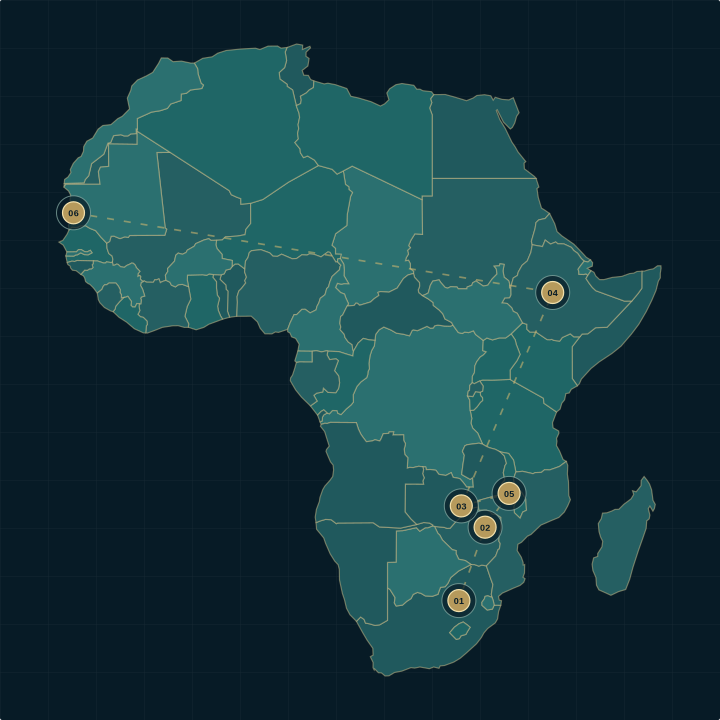
Africa's mineral economies operate across distinct legal, institutional and commercial environments. MEI approaches each mandate on its own terms while designing for the connections that allow productive systems to scale.
Work begins with lawful mandate, accountable institutions and locally defined priorities.
Infrastructure and technical capacity are structured around the wider activity they can enable.
Complementary capabilities can connect production, services and knowledge across borders.
Development pathways are anchored to quality, traceability and identifiable demand.
Facilities and services that improve productive access, consistency and scale.
Credible measurement, verification and technical controls that support lawful trade.
Commercial structures that strengthen domestic participation and productive ownership.
Coordinated systems for formal supply, quality assurance and accountable delivery.
Selective processing and service infrastructure where sector-wide utility can be established.
Alignment between production capability, buyer specifications and long-term demand.
Operating standard
Every initiative is evaluated against applicable law, delivery authority, environmental responsibility, commercial durability and the wider activity it can enable.
A productive first discussion identifies the priority, the implementation gap and the authority required to assess a credible development pathway.
Strategic alignment · institutional requirements · preliminary project pathway